Towards the Development of Bias-Corrected Rainfall Erosivity Time Series for Europe

Rainfall erosivity maps for (near) real-time soil erosion predictions require the integration of (combinations of) reanalysis products and satellite retrievals of rainfall while overcoming biases related to their simplified spatial and temporal scales. Across Europe, this study evaluates the European Meteorological Observations (EMO) dataset and different implementations of quantile delta mapping (QDM) bias correction to improve rainfall erosivity prediction between 1990 and 2014.

more ...


How the EU Soil Observatory Is Providing Solid Science for Healthy Soils

Healthy soils are essential for sustainable food production, climate neutrality, and biodiversity conservation. This article presents an overview of the EU Soil Observatory (EUSO), its role in supporting EU soil monitoring and policy development, and its contributions to soil research, data infrastructure, and the assessment of soil health across Europe.

more ...


Soil bulk density assessment in Europe

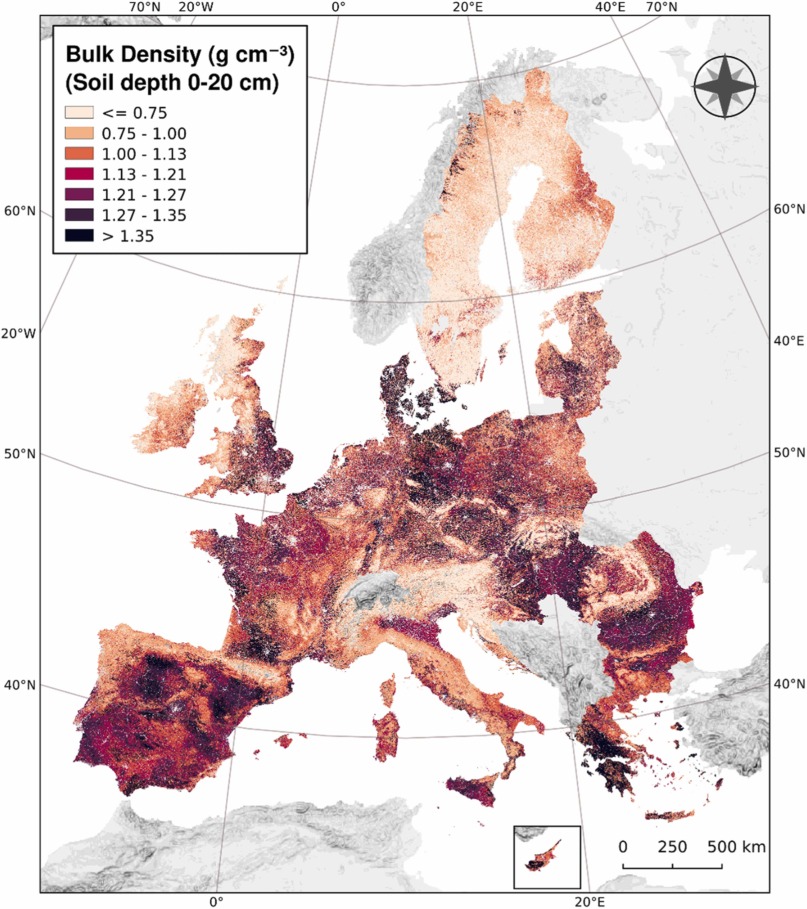
The topsoil Land Use and Cover Area frame Statistical survey (LUCAS) aims at collecting harmonised data about the state of soil health over the extent of European Union (EU). In the LUCAS 2018 survey, bulk density has been analysed for three depths, i.e., 0–10 cm = 6140 sites; 10–20 cm = 5684 sites and 20–30 cm =139 sites. The laboratory analysis and the assessment of the results conclude that the bulk density at 10–20 cm is 5–10% higher compared to 0–10 cm for all land uses except woodlands (20%).

more ...


Brief communication. A first hydrological investigation of extreme August 2023 floods in Slovenia, Europe

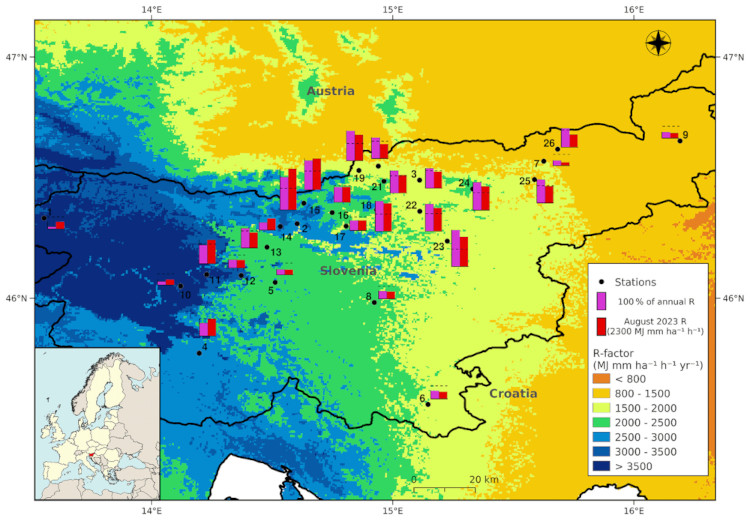
Extreme floods occurred from 4 to 6 August 2023 in Slovenia causing three casualties and causing total direct and indirect damage, including post-disaster needs according to the Post-Disaster Needs Assessment (PDNA), close to EUR 10 billion. The atypical summer weather conditions combined with the high air and sea temperatures in the Mediterranean and the high soil moisture led to the most extreme flood event in Slovenia in recent decades. The return periods of both daily and sub-daily precipitation extremes and peak discharges reached 250–500 years, and the runoff coefficient of a typical torrential and mostly forested mesoscale catchment was around 0.5. In addition, flooding, soil erosion, mass movements and river sediment transport processes caused major damage to buildings (more than 12 000 houses) and diverse infrastructure.

more ...


Understanding the cost of soil erosion. An assessment of the sediment removal costs from the reservoirs of the European union

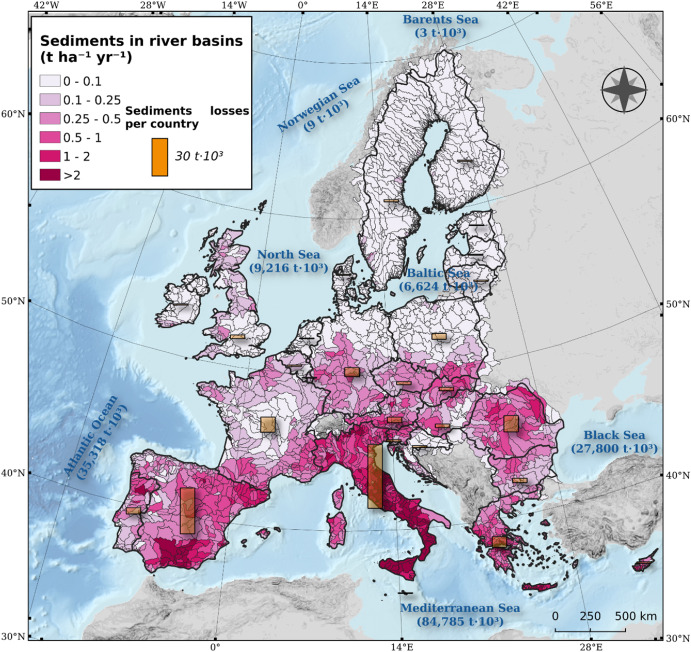
Soil erosion is both a major driver and consequence of land degradation with significant on-site and off-site costs which are critical to understand and quantify. One major cost of soil erosion originates from the sediments delivered to aquatic systems (e.g., rivers, lakes, and seas), which may generate a broad array of environmental and economic impacts. As part of the EU Soil Observatory (EUSO) working group on soil erosion, we provide a comprehensive assessment of the existing costs of sediment removal from European Union (EU) catchments due to water erosion.

more ...


Global rainfall erosivity database (GloREDa) and monthly R-factor data at 1 km spatial resolution

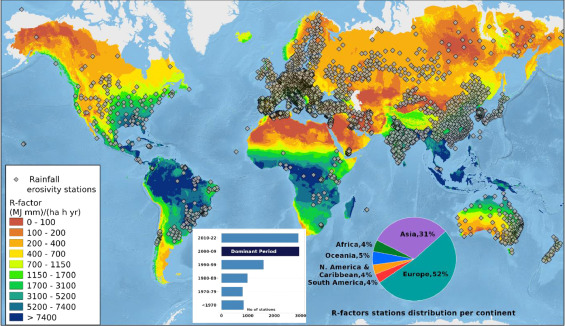
Here, we present and release the Global Rainfall Erosivity Database (GloREDa), a multi-source platform containing rainfall erosivity values for almost 4000 stations globally. The database was compiled through a global collaboration between a network of researchers, meteorological services and environmental organisations from 65 countries. GloREDa is the first open access database of rainfall erosivity (R-factor) based on hourly and sub-hourly rainfall records at a global scale. This database is now stored and accessible for download in the long-term European Soil Data Centre (ESDAC) repository of the European Commission's Joint Research Centre. This will ensure the further development of the database with insertions of new records, maintenance of the data and provision of a helpdesk.

more ...


EUSEDcollab, a network of data from European catchments to monitor net soil erosion by water

As a network of researchers we release an open-access database (EUSEDcollab) of water discharge and suspended sediment yield time series records collected in small to medium sized catchments in Europe. EUSEDcollab is compiled to overcome the scarcity of open-access data at relevant spatial scales for studies on runoff, soil loss by water erosion and sediment delivery. Multi-source measurement data from numerous researchers and institutions were harmonised into a common time series and metadata structure.

more ...


Ecosystem type drives soil eukaryotic diversity and composition in Europe

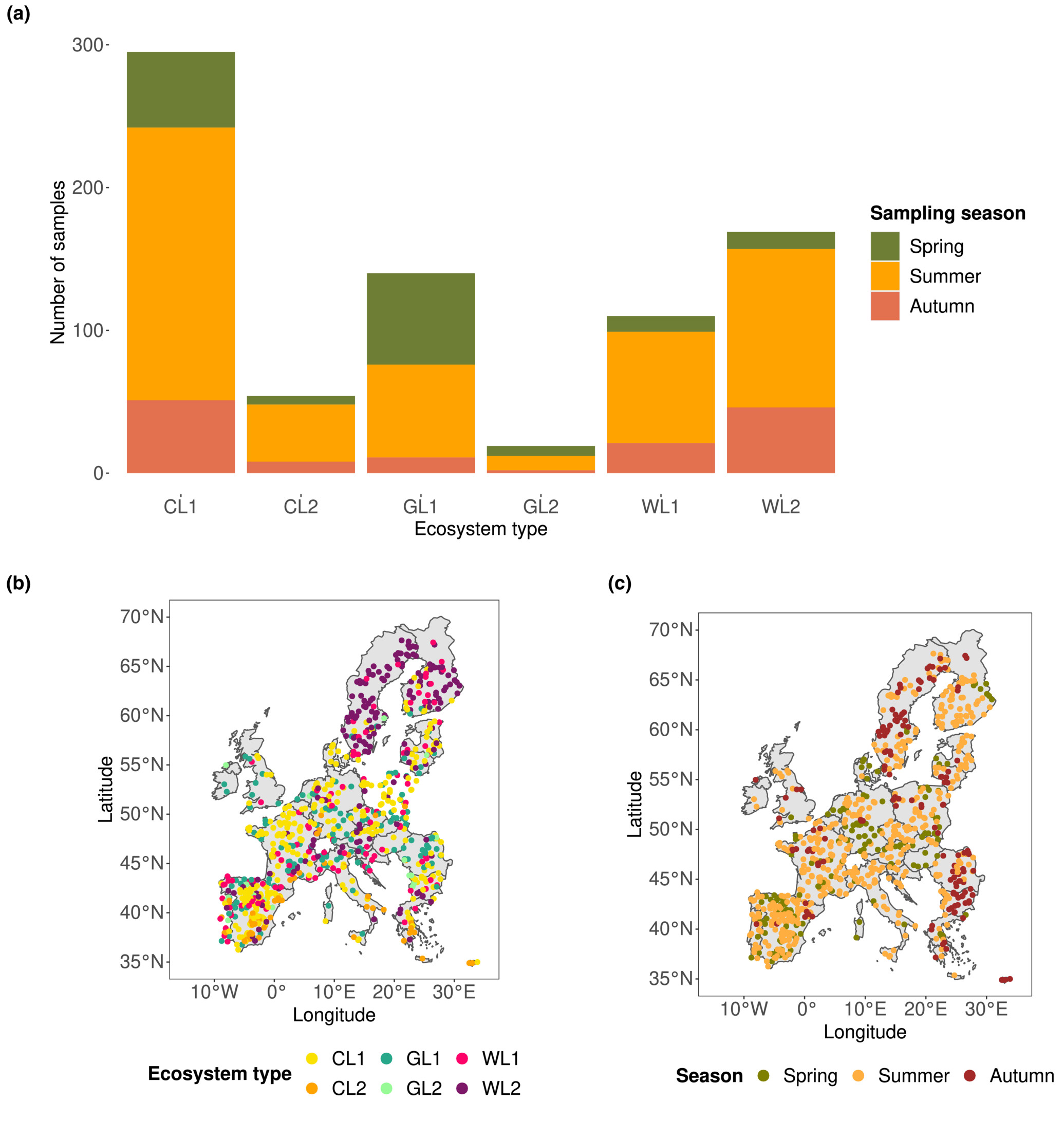
Soil eukaryotes play a crucial role in maintaining ecosystem functions and services, yet the factors driving their diversity and distribution remain poorly understood. While many studies focus on some eukaryotic groups (mostly fungi), they are limited in their spatial scale. Here, we analyzed an unprecedented amount of observational data of soil eukaryomes at continental scale (787 sites across Europe) to gain further insights into the impact of a wide range of environmental conditions (climatic and edaphic) on their community composition and structure.

more ...


Challenges in the Geo-Processing of Big Soil Spatial Data

This study addressed a critical resource—soil—through the prism of processing big data at the continental scale. Rapid progress in technology and remote sensing has majorly improved data processing on extensive spatial and temporal scales. Here, the manuscript presents the results of a systematic effort to geo-process and analyze soil-relevant data.

more ...


European Soil Data Centre 2.0. Soil data and knowledge in support of the EU policies

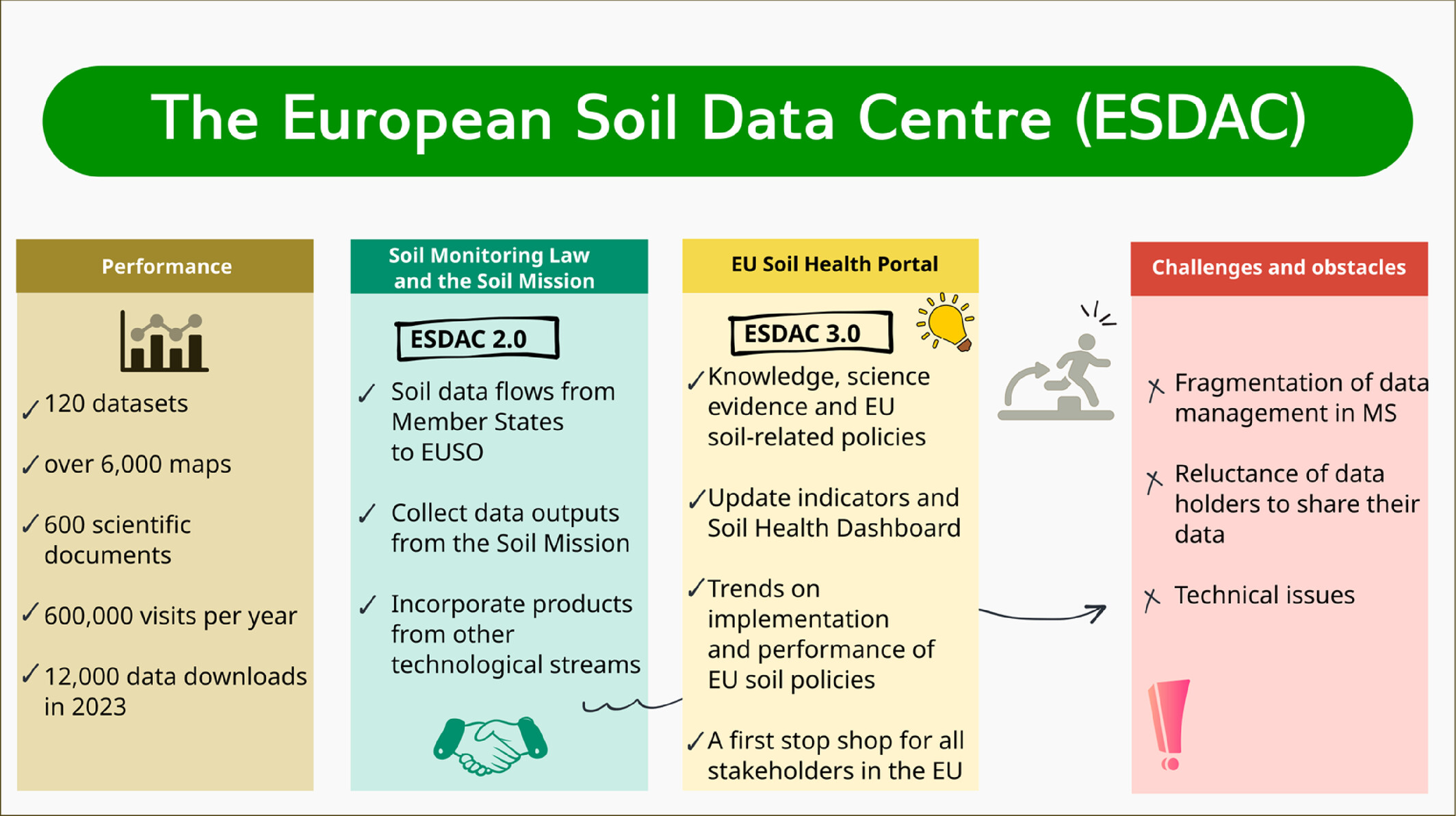
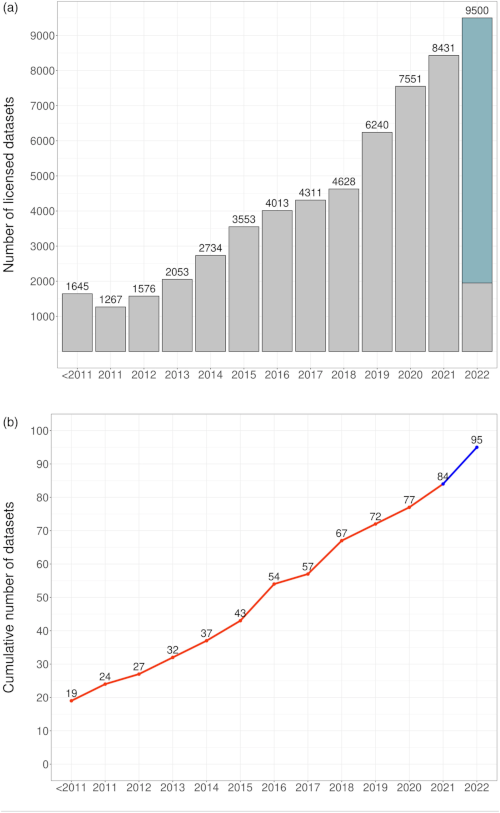
The European Soil Data Centre (ESDAC), hosted by the European Commission's Joint Research Centre (JRC), is the focal point for soil data, support to policy making and awareness raising for the European Union (EU). Established in 2006 to provide harmonised soil-related information for the EU Member States, and ESDAC currently hosts 88 datasets, 6000 maps, six atlases, 500 scientific publications, and a copious amount of soil-related material. Through its data repository publishing activity, ESDAC has licensed over 50,000 datasets during the past 15 years; 8500 of them in 2021 alone. It has published 140 monthly newsletters and is followed by more than 12,000 subscribed users, which receive regular updates. This article addresses the use, usability, and usefulness of ESDAC. About 75% of the ESDAC users come from academia and the research community while the remaining 25% includes public administration (at EU, national, regional, and local level) and the private sector. In addition, we provide some insights of the datasets evaluation and how they have been developed. The general ESDAC vision is to provide evidence underlying EU soil-relevant policies and to facilitate the access to relevant data for research. ESDAC is an integral part of the recently established European Union Soil Observatory (EUSO), with a target to have an even stronger role in supporting EU and regional policies.

more ...